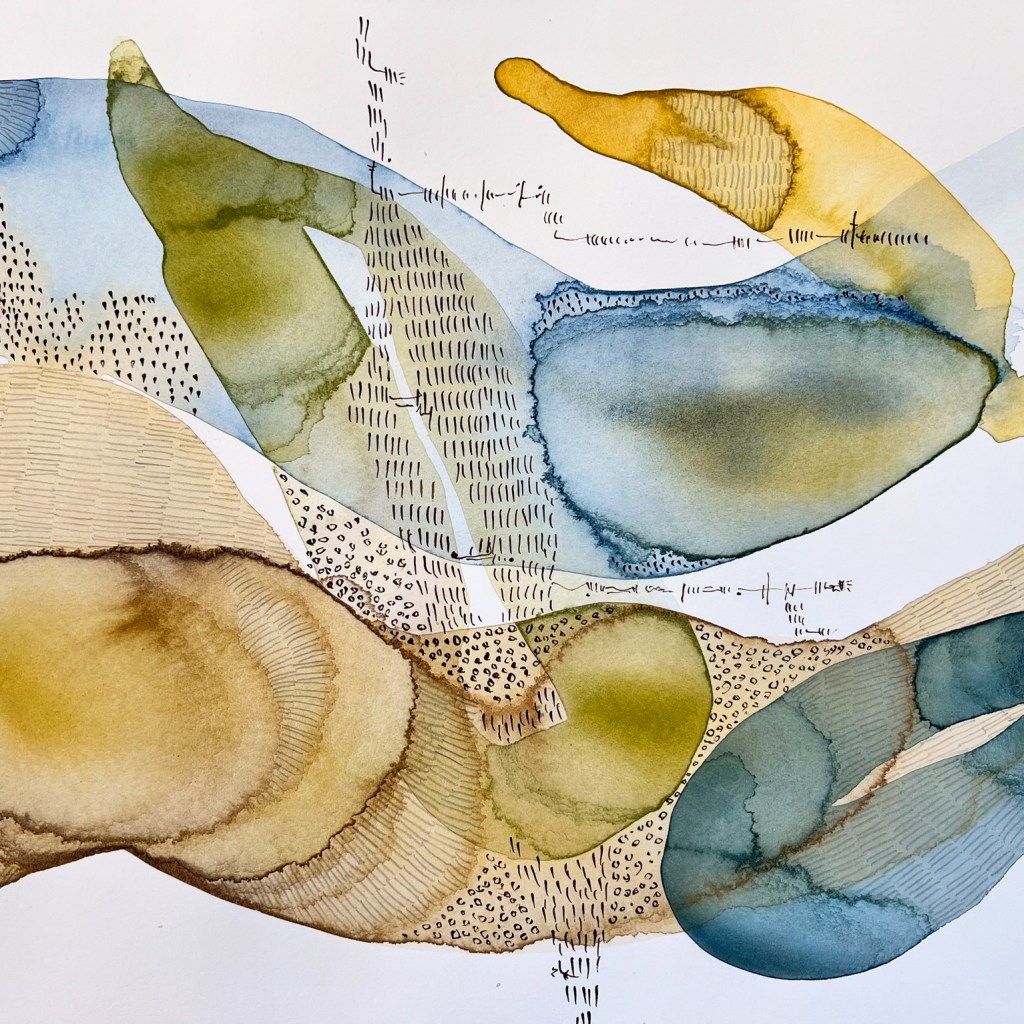
I create abstract work in watercolour and collage. Both offer the opportunity to create work using layers of transparency. There’s something compelling about transparency, about seeing beneath the surface, seeing what lies beneath.
I’m drawn to watercolour because it’s such a playful medium. Its fluidity and unpredictability are always a source of delight. I love the anticipation of seeing how wet pools of colour – I always work very wet – have dried overnight. I’m often surprised.
And I’ve had a long obsession with paper. Maybe I was a stationer in a previous life? The beautiful textures of cotton watercolour papers were part of the attraction to that medium. Now I’m working more into collage, I’m collecting and creating a enormous stockpile of textured and transparent papers. God help me – my studio is overflowing!
My process
I work intuitively without sketching ideas or trying to conceptualise an outcome. Letting the work evolve is particularly useful when working with watercolours – they are known for having a mind of their own! I usually begin with a series of very wet washes, preferring organic forms and a limited palette. I almost always finish a work by adding marks with liquid watercolour and a dip pen, or with graphite in pencil or crayon form. These create movement within and across the watercolour forms. I think of them like the lines of text in a poem, or tracks meandering through a landscape. And I feel these marks help in making for a more cohesive composition.
In my collage work, I use tissue papers mostly. I colour and make marks on the tissue paper with acrylic paint or inks by scribbling, stamping, and gel plate printing. I combine the tissue papers with pieces of paper torn or cut from old books. And I’ve become fond of old brown dressmakers’ pattern paper – the lines and text add interest to the work.

Emerging from the shadows
In ‘The Artists Way’, Julia Cameron suggests that many people fail to recognise that they have an artistic dream and instead become ‘shadow artists’, living their lives ‘shadowing declared artists’. She says:
Artists love other artists. Shadow artists are gravitating to their rightful tribe but cannot yet claim their birthright.
I didn’t go to art school. If I had a creative dream it was obscured by my parents’ and teachers’ enthusiasm for my academic ability. But I’ve always kept the company of artists. Helsy, my schoolfriend who ended up going to art school (but sadly died at age 21 before realising her full potential). Julie, my former housemate and printmaker. Maxienne, my surrealist artist friend from uni. I was always just a little bit envious of them, though each one was adamant that creativity was in all of us.
After moving back to Kyabram in late 2014, I started curating shows at the town hall gallery, organising exhibitions with work from several artist friends in Melbourne, as well as creatives from the surrounding regions. And I project managed a successful community arts project focused on photography and Instagram. So I was dipping my toe into the art world in a new way.
In the end it was Maxienne who made me sit in her sunroom in Toowoomba and paint the field behind her house, insisting I was a natural in spite of my clumsy first efforts. When I got home and started painting watercolours, she asked me to send her photos, and always gave enthusiastic feedback. By the time I decided to build a studio in my garage she was quite ill, and she died just a few months after it was finished. She’d be overjoyed to see that I’m finally emerging from the shadows.
My latest venture in art is as the project lead for an open studio event in our local area. The Campaspe Artists Studio Trail was held for the first time in February 2025. We had 27 artists and makers participate across 10 towns. And we were delighted to attract over 300 visitors from 97 different postcodes. It was a really fun weekend for all.
 Dey Alexander
You must be logged in to post a comment.